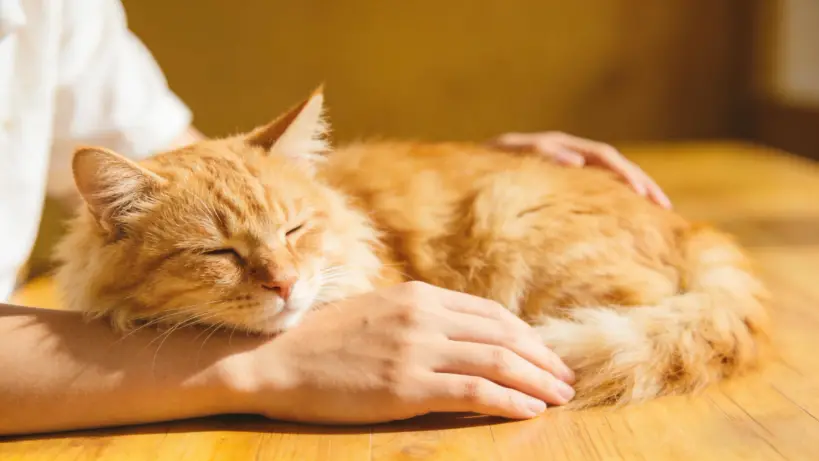

✨ A relatable frustration for all cat owners: You call your cat’s name at the top of your lungs, but it doesn’t move a muscle; yet, the moment you tear open a snack bag, it “appears” instantly even from another room. In fact, you’ve wronged it—your cat isn’t ignoring you because it didn’t hear you, but because it’s turned on “selective deafness” mode. Scientists have confirmed: cats can accurately recognize their owners’ voices; they just decide whether it’s “worth responding to.”
Self-Check: Is Your Cat “Selectively Deaf”?
Check if your cat has these “double standard” behaviors:
- Calling its name: Ignores you completely, acting as if you’re “talking to the wind”;
- Tearing snacks/can opening: Wakes up instantly and runs over quickly;
- Ignores irrelevant sounds (walking, page-turning) but immediately alerts to unfamiliar noises (neighbor’s cat meowing, sparrow chirping);
- Hides when you call it angrily, but only approaches when you coax it gently with toys.
This is a cat’s “selective deafness”—actively filtering sounds, listening carefully to useful ones and blocking out useless ones entirely.

Scientific Proof: Cats Can Accurately Recognize Their Owners’ Voices
In 2013, researchers from the University of Tokyo published an experiment in the authoritative academic journalAnimal Cognition: When 20 domestic cats couldn’t see their owners, they showed obvious orienting responses (perking up ears, turning heads) upon hearing their owners’ calls, proving they could accurately recognize their owners’ voices. However, most of them would “read but not reply.”
A cat’s hearing is 3 times more sensitive than a human’s. Their ears have more than 30 muscles that can rotate 180 degrees independently, allowing them to hear high-frequency sounds that humans can’t. It’s not that they didn’t hear you—it’s that they heard you too clearly and chose to ignore you.
Revealed: 3 Core Reasons Why Cats “Pretend to Be Deaf”
Cats don’t “pretend to be deaf” because they’re cold-hearted; it’s an instinct engraved in their bones:
1: Survival Instinct—Prioritizing Danger Judgment
Cats are naturally vigilant by nature. Even after thousands of years of domestication, they still retain the caution of wild survival. When you call them suddenly, their first reaction isn’t “My owner is calling me,” but “Is this sound safe? Is there a trap?” Your call is classified as a “non-urgent signal,” and they may only respond after confirming safety—whether they come over or not depends entirely on their mood.
2: Value Judgment—Only Caring About “Useful Sounds”
Cats follow the principle of “maximizing benefits”: they will definitely respond to high-value sounds (snacks, toys), block out negative-value sounds (bathing, nail clipping), and respond to neutral calls (just calling their name) based on their mood.
3: Independent Personality—They Are Their Own “Masters”
Unlike dogs, the relationship between cats and humans is never a “subordinate relationship,” but a “cooperative relationship.” About 9,000 years ago, wild cats took the initiative to approach humans to hunt mice near grain stores, exchanging their mouse-hunting services for food and shelter—without signing any “obedience agreement.” In a cat’s world, it is the absolute master of its territory. When you call it over, it sees it not as an “order,” but as a “request from a human.” If it’s not in the mood, it will show its status by ignoring you—”Want me to move? You have to come coax me personally, or bring something sincere enough.”
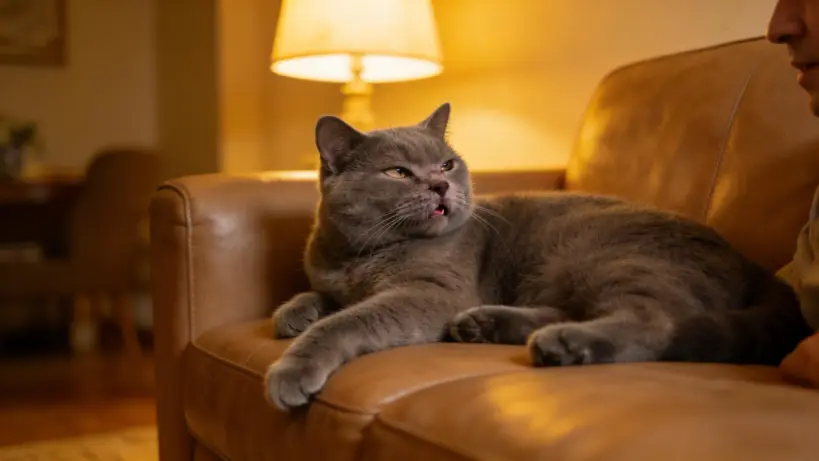
Misconception: These 3 Situations Are Not “Pretending to Be Deaf”
Not all unresponsiveness is “pretending to be deaf”; be alert to these 3 situations:
- Overloaded concentration: When it’s fully focused on observing or playing, your call will be treated as background noise;
- Hearing problems: If it doesn’t respond to snack bags or door opening sounds, accompanied by ear abnormalities, take it to the vet in time (white cats with blue eyes have a higher probability of congenital deafness);
- Bad mood: When criticized or not played with enough, it will express dissatisfaction by ignoring you and will take the initiative to approach you after calming down.
Tips: 4 Ways to Get Your Cat to Respond to You
To get your cat to respond actively, the key is to make your call valuable:
- Link its name to “good things”: Only call its name when feeding snacks or playing with it; avoid calling it when criticizing it;
- Add fun: When calling it, squat down, clap your hands, or shake its favorite cat teaser to reduce the burden of interaction;
- Respect its unresponsiveness: Don’t force interaction or criticize it; give it enough space;
- Reward guidance: Immediately give it freeze-dried treats or gentle pets after it responds to form a conditioned reflex.

Frequently Asked Questions (FAQ)
Q1: Can cats understand their owners’ words?
They can recognize their owners’ voices and tones, but they don’t understand the specific meaning of language. They judge based on the association between “sound and situation” (e.g., “dinner time” is associated with eating).
Q2: Why do cats sometimes respond to strangers’ calls but not their owners’?
A stranger’s voice is a new stimulus, and they will respond out of vigilance; their owner’s voice is too familiar, so they will ignore it if there’s no benefit.
Q3: Do kittens and adult cats differ in their degree of “pretending to be deaf”?
Yes! Kittens are curious and respond more actively; adult cats (over 3 years old) are more independent and “pretend to be deaf” more obviously.
Q4: How to tell if a cat is “pretending to be deaf” or has hearing problems?
Test it with a snack bag or cat teaser. If it responds, it’s “pretending to be deaf”; if it doesn’t respond and has ear abnormalities, take it to the vet.
💡 Finally, it’s worth saying: A cat’s “selective deafness” is both instinct and independence. Raising a cat is a two-way journey—you respect its rhythm, and it will love you in its own way. Next time you can’t get your cat to respond, don’t be angry—it’s just saying: “I know, I’ll come to you after I’m done~”