

Many pet owners spend a lot of money on imported dry food, only to find their fur babies getting thinner, having smelly stools, dry fur, and even frequent loose stools or vomiting — it’s not that the dry food you bought is not good enough, but the inherent flaws of dry food are destined to make its nutrient absorption efficiency far lower than that of fresh food. Today, we’ll get straight to the point, help you see the “hidden shortcomings” of dry food, teach you to choose food scientifically, and let your fur babies eat healthily and get sick less!
1. Core Data Impact: Why Have 39.2% of Pet Owners Switched to Fresh Food?
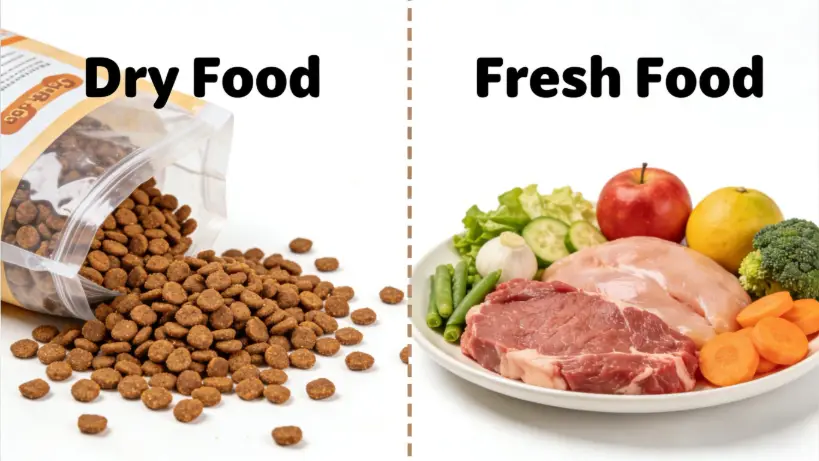
You may still be hesitating, “Dry food is convenient, fresh food is troublesome,” but data doesn’t lie — according to the latest survey on China’s pet food industry, more than one-third (39.2%) of pet owners have switched from dry food to fresh food as their fur babies’ staple food, and 80% of them said their pets’ health has improved significantly after the switch.
More striking is another set of data: under the same nutritional ratio, the nutrient absorption rate of dry food is only about 65%, while that of fresh food is as high as 94.8% — the gap between the two is a full 29.8%! This means that for every 100 yuan you spend on dry food, 35 yuan worth of nutrients are “wasted” in your pet’s feces; while the same 100 yuan spent on fresh food allows almost all nutrients to be absorbed and utilized by the body.
In addition, pet owners who switched to fresh food have noticed 3 intuitive changes (from real pet owner feedback):
- ✅ Less stool volume and lighter odor (better absorption means less waste)
- ✅ Smoother and shinier fur, no more dryness or shedding
- ✅ More stable gastrointestinal health, almost no loose stools or vomiting
It’s important to remember that most pets only live for more than a decade, and the efficiency of nutrient absorption from their diet directly determines their health and lifespan. 39.2% of pet owners have already made their choice — what about you?
2. Truth Uncovered: Why Is Dry Food’s Nutrient Absorption 29.8% Lower?
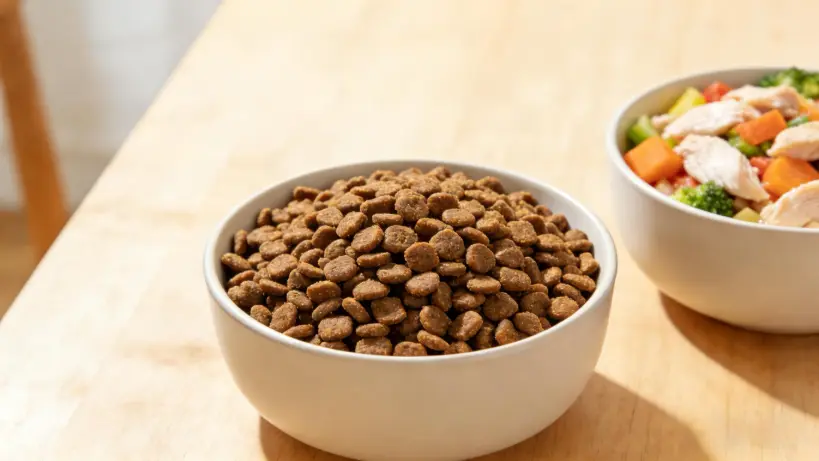
Many people think the difference between dry food and fresh food is just “dry” vs. “wet” — that’s a big mistake! The core gap between them lies in processing technology, ingredient status, and nutrient retention, which is the fundamental reason for the 29.8% difference in nutrient absorption.
1. Processing Technology: High-Temperature Extrusion = Nutrient “Killer”
The core processing method of dry food is “high-temperature extrusion,” with temperatures usually between 120-180℃. Although this process can extend shelf life and facilitate storage, it causes massive nutrient loss in the ingredients:
✅ Protein Denaturation: High temperatures destroy high-quality proteins in meat, making them difficult for fur babies’ gastrointestinal tracts to digest and absorb, so they can only be excreted;
✅ Vitamin Loss: Most water-soluble vitamins (such as B vitamins and vitamin C) decompose directly at high temperatures — even if a lot is added to the raw materials, very little is ultimately absorbed;
✅ Moisture Loss: The moisture content of dry food is only 5%-10%, while pets’ gastrointestinal tracts are more adapted to moist food. Dry food increases gastrointestinal burden and further reduces absorption efficiency.
Fresh food, on the other hand, uses “low-temperature steaming” or pasteurization, with temperatures controlled at 70-90℃. This not only kills harmful bacteria but also maximizes the retention of nutrients and moisture in the ingredients, making nutrients easier for the gastrointestinal tract to absorb — this is the key reason why fresh food’s absorption efficiency is far higher than that of dry food.
2. Ingredient Status: “Dehydrated Processing” vs. “Fresh Direct Supply”
To ensure long-term storage, dry food ingredients are dehydrated, crushed, and then pressed into pellets — during this process, the natural fiber of the ingredients is destroyed, and the texture becomes hard. This is not only unfavorable for pets to chew and digest but also may increase tooth burden (many pet owners think dry food can clean teeth, but in fact, it’s mostly particle friction with limited effect).
Fresh food uses fresh ingredients, mostly visible meat pieces and vegetables, without dehydration or crushing, retaining the natural form and fiber structure of the ingredients. Just like humans get more nutrients and digest better from fresh vegetables than dehydrated ones, fur babies have less gastrointestinal burden and better absorption when eating fresh food.
3. Additives: Hidden Burden That Slows Absorption
To extend shelf life, almost all dry food contains preservatives and antioxidants; to improve palatability, attractants are also added. Although these additives are within national standards, long-term intake will increase pets’ gastrointestinal burden, disrupt the balance of intestinal flora, and thus affect nutrient absorption — this is also an important reason why many fur babies are prone to loose stools and pickiness when eating dry food.
High-quality fresh food mostly adopts a short shelf-life design, relying on cold chain preservation, so it does not need to add too many preservatives, and can even achieve “zero additives,” reducing gastrointestinal irritation and making nutrient absorption smoother.
3. Fresh Food vs. Dry Food: Comprehensive Comparison (Must-See for Newbies)
To help you see the gap between the two more intuitively, we’ve sorted out a comparison table — newbies can directly refer to it to avoid pitfalls!
| Comparison Dimension | Dry Food | Fresh Food |
| Nutrient Absorption Rate | About 65%, 29.8% gap | About 94.8%, high-efficiency absorption |
| Processing Technology | High-temperature extrusion, high nutrient loss | Low-temperature steaming/pasteurization, nutrient retention |
| Moisture Content | 5%-10%, prone to pet dehydration | 70%-80%, replenishes moisture, prevents urinary problems |
| Additives | Contains preservatives and attractants, long-term burden | Few/no additives, relies on cold chain preservation |
| Palatability | Relies on attractants, some pets are picky | Natural meat aroma, good palatability, perfect for picky eaters |
| Storage Method | Room temperature storage, convenient | Refrigerated/frozen, need to pay attention to preservation |
| Applicable Scenarios | Short-term feeding, backup for business trips | Long-term staple food, suitable for pet owners focusing on health |
To sum up: Dry food wins in convenience, while fresh food wins in health. If conditions permit, prioritize fresh food; if you’re busy at work, you can also adopt a “dry food + fresh food” mixed feeding method to balance convenience and health (veterinarian-recommended mixed feeding plan: dry food during the day, fresh food at night).
4. Newbies’ Guide to Choosing Fresh Food: 3 Steps to Avoid All Pitfalls (With New National Standard Reference)
With the boom in the fresh food market, more and more merchants are following the trend, which inevitably leads to “shoddy products” — many products are labeled as “fresh food” but actually have poor-quality ingredients and unbalanced nutrition, which can harm fur babies. Combined with China’s first national standard for fresh pet food, we’ll teach you 3 steps to choose reliable fresh food — newbies can copy directly!
Step 1: Check the Label, Recognize the New National Standard “ID”
China’s first “General Technical Specification for Complete Fresh Pet Food” has been officially implemented. When choosing fresh food, first check if there is a clear standard code on the package — this is the “bottom line” for qualified products. Also, pay attention to 2 points:
- ✅ Transparent Ingredient List: The first ingredient must be a specific type of meat (such as “chicken breast” or “beef”), not vague descriptions like “meat and its products”; it should also clearly indicate whether the raw materials are fresh or frozen meat;
- ✅ Complete Nutritional Labeling: Core indicators such as crude protein, crude fat, and calcium-phosphorus ratio must be clear to avoid merchants filling with starch, ensuring complete nutrition that meets pets’ daily needs.
Step 2: Check Quality Control, Avoid 5 Common Pitfalls
Many pet owners easily fall into pitfalls when choosing fresh food. Remember these 5 pitfalls to avoid 90% of shoddy products directly:
- ❌ Pitfall 1: “Pure Meat” Is Everything — Pure meat is nutritionally unbalanced. Good fresh food needs to scientifically add vitamins and minerals to avoid nutritional deficiencies from long-term feeding;
- ❌ Pitfall 2: Blind Belief in “No Preservatives” — Short-shelf-life fresh food can be preservative-free, but if it can be stored at room temperature for half a year and still claims to be “preservative-free,” be alert to hygiene risks;
- ❌ Pitfall 3: Blindly Advocating “Raw Food” — Raw food has high risks of parasites and bacteria, which is difficult to handle properly at home and rarely recommended by veterinarians;
- ❌ Pitfall 4: The More Expensive, the Better — A high price may be due to high marketing costs; focusing on the ingredient list and nutritional components is more reliable than just looking at the price;
- ❌ Pitfall 5: Sudden Full Food Switch — No matter how good the fresh food is, a sudden switch will cause gastrointestinal discomfort. It needs to be replaced gradually over 7-10 days.
Step 3: Observe Reactions, Trial Feeding Is Key
Every fur baby has a different constitution, so the suitable fresh food is also different. For newbies, be sure to buy trial packs first:
- ✅ Observe Palatability: See if your fur baby likes it — the natural meat aroma of fresh food cannot be replaced by attractants;
- ✅ Observe Gastrointestinal Reactions: Observe for 1 week after switching food — formed stools with no odor indicate gastrointestinal adaptation;
- ✅ Observe Long-Term Changes: After 1-2 months, check if the fur becomes smoother and the mental state improves — these are signs of adequate nutrient absorption.
5. Frequently Asked Questions (FAQ) to Address All Your Concerns
Q1: Is feeding refrigerated fresh food troublesome?
A: No. Independent small packs, warm up 10-15 mins after taking out of the fridge; freeze in advance for business trips.
A: No. It comes in independent small packs; take it out of the fridge to warm up for 10-15 minutes. Freeze in advance for business trips—simple and healthy.
Q2: Fresh food is more expensive than dry food. Is long-term feeding a burden?
A: No. Its high absorption rate and lower medical costs make it more cost-effective long-term.
Q3: Can puppies/senior pets eat fresh food?
A: Yes, it’s more suitable — easy to absorb for puppies and gentle for seniors.
Q4: Is it feasible to make fresh food at home?
A: Not recommended. It’s hard to ensure nutrition balance; commercial fresh food is safer and easier.
Q5: Do I still need to feed extra water when feeding fresh food?
A: Yes, a small amount. Fresh food provides most moisture, but a bowl of water is safer.
Q6: Will fresh food replace dry food?
A: Not short-term. Dry food is still mainstream; mixed feeding is the best balance of convenience and health.
(Ending Sublimation) Raising a pet is like raising a child — we always want to give them the best, and the best care starts with “eating the right food.” 39.2% of pet owners have switched to the fresh food camp, and the 29.8% nutrient absorption gap is behind the health gap of fur babies.
Don’t ignore your fur baby’s gastrointestinal health because of “convenience.” Starting today, try switching your fur baby to fresh food — you’ll find their stools improve, their fur becomes shiny, and they’re more energetic — this visible change is the best reward for us.
Final Reminder: When choosing fresh food, recognize the new national standard, check the ingredient list and quality control, avoid pitfalls, and feed scientifically to let your fur baby accompany you longer~